
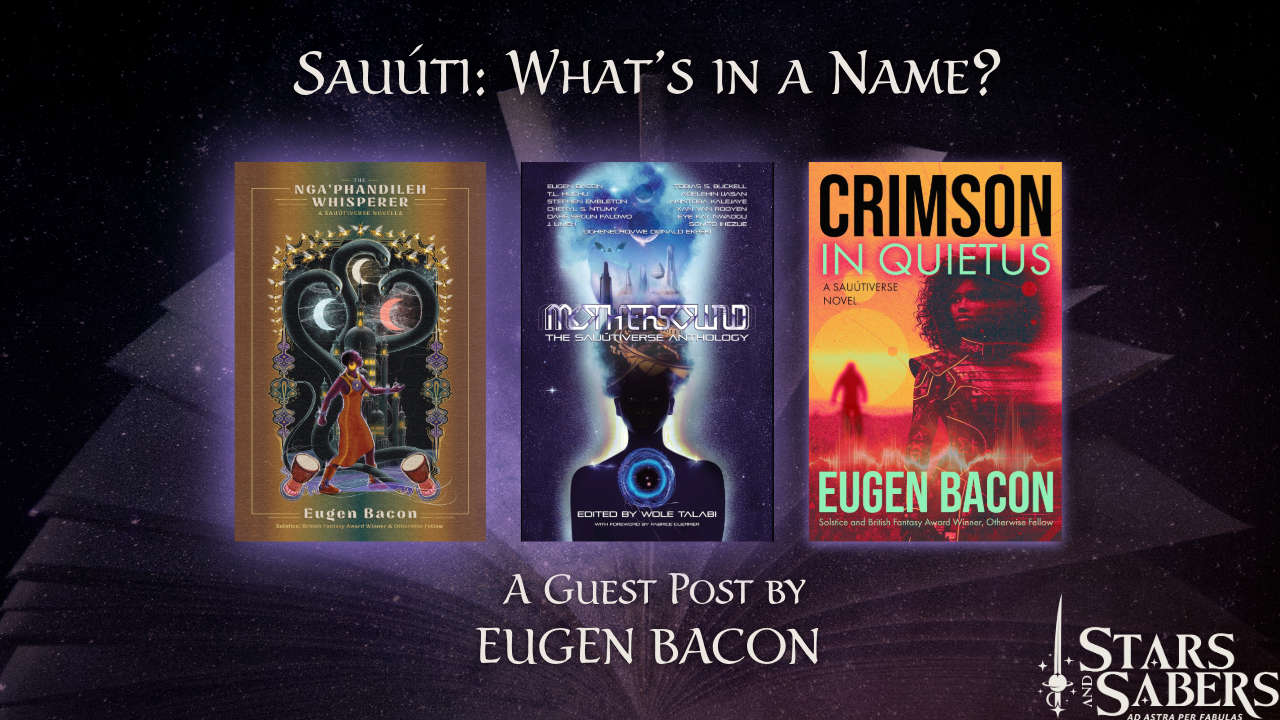
Today, we are featuring a guest post by Eugen Bacon, author of The Nga’phandileh Whisperer!
Khwa’ra.[It is acquired].
Ya’yn. [It is uttered].
Ra’kwa. [It is released (whoosh of air)].
Hark! The song of Our Mother, as she begets planets in the Sauúti origin story by Wole Talabi and Stephen Embleton.
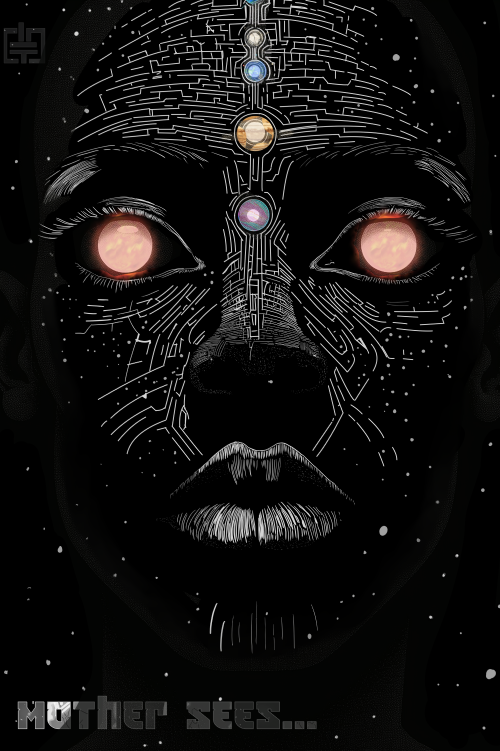
This year ushers in the 4th anniversary of the Afrocentric Sauútiverse, our collaborative world orbiting a binary star ( Zuúv’ah and Juah-āju) and two spirit moons (Vuiili-ki and Vuiili-ku) that I explore in The Nga’phandileh Whisperer: A Sauútiverse Novella.
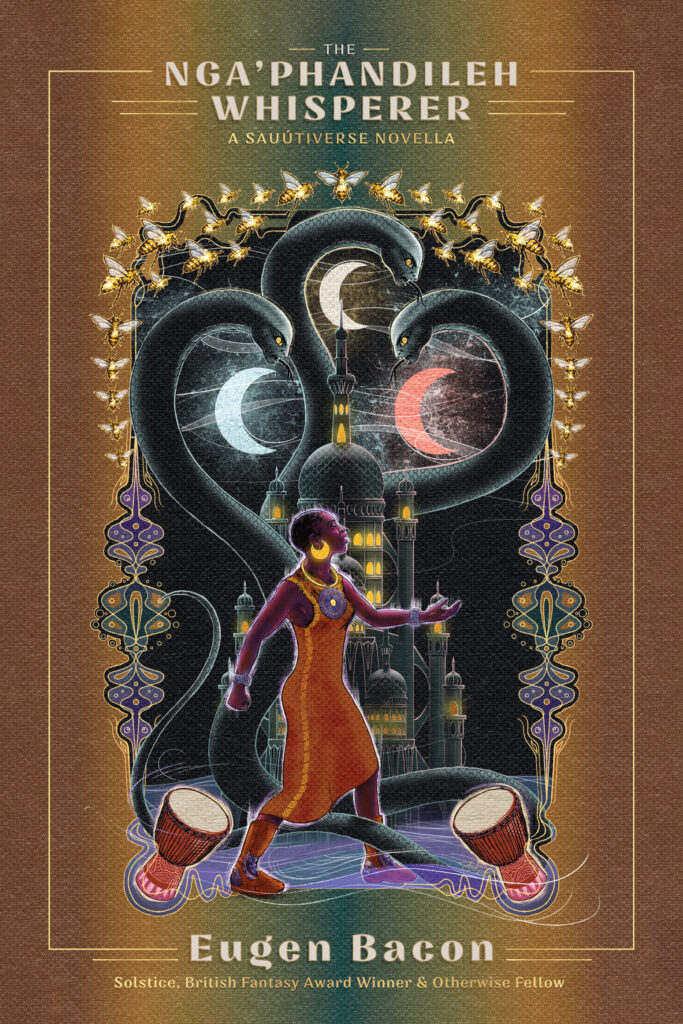
The novella interrogates themes of othering, revenge, belonging and misuse of power. I sought to craft this story to satiate my curiosity about the Nga’phandileh, creatures of unreality in the Sauútiverse. I also wanted to write a strong female protagonist into a Sauúti story, and found this in Chant’L—a young Guardian with an affinity to hive-minded beasts, unaware that she has more sound magic than she knows how to use.
As I contemplated where to set the story, I scrutinized the five Sauútiverse planets, each named after the word ‘song’ from an African language:
- Zezépfeni—from the Amharic word “zefeni”—rapid seasonal changes, where a desert could evolve into an ocean—rendering it the perfect planet for climate action stories.
- Wiimb-ó—from the Swahili word “wimbo”—an earth analogue planet, more fitting for primary worlds.
- Órino-Rin—from the Yoruba word “orin”—a ‘gas giant’ with a dense atmosphere, and subject to sonic storms, great for climate action or tales of inequity, where the wealthy live in high altitudes and the poor face the ire of the storms.
- Ekwukwe—from the Igbo word “ukwe”—an echo planet comprising caverns and networks of holes and caves that create echoes.
- Pinaa—an inhabited moon from the Setswana word “pina”—exposed to meteor rocks and apt for technology stories due to its dominant AI populace.
Because the Guardians are a prayer faction of Jurors, a class of powerful warriors who protect the Hogiiri Hile Halah, a wall holding off the perilous Nga’phandileh, I set a segment of the story in New Inku’lulu, a Zezépfeni look alike space station.
More of the story unravels in the Island of Silence, a fictitious no-place that’s some place—a fate our precocious protagonist Chant’L must suffer when she misappropriates her sound magic. It disentangles in Wiimb-ó, the Earth-analogue planet, whose spirit moons channel energy to help outcast Chant’L reclaim her powers.
As I fondly reminisce about the Sauútiverse, I hark back to my first story, “Sina, the Child with No Echo”, in Mothersound: A Sauútiverse Anthology.
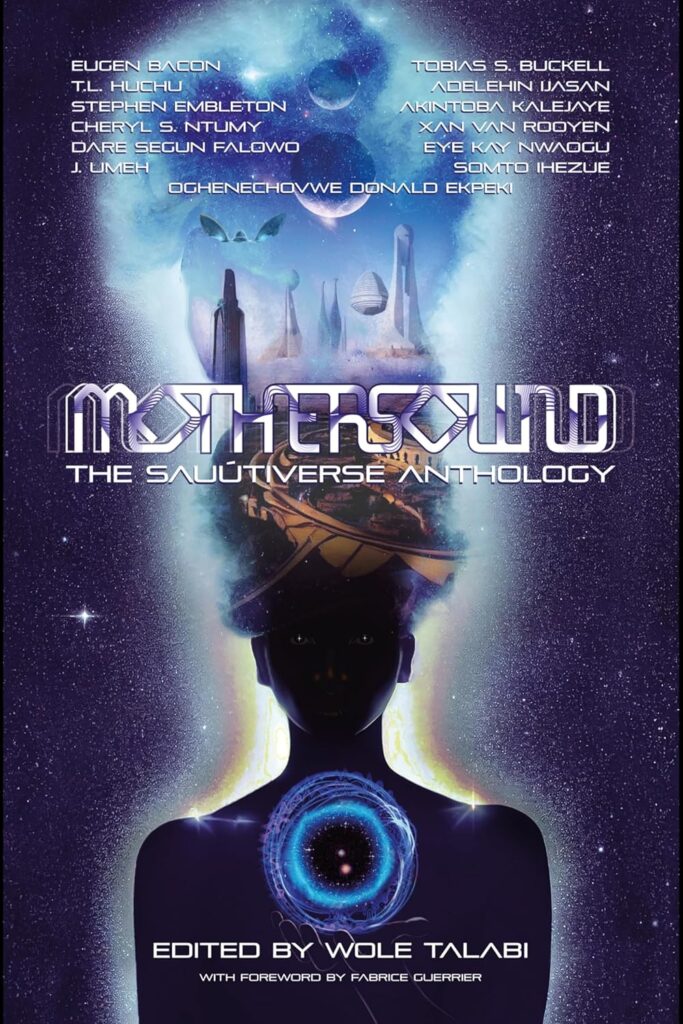
“Sina” explores echoes, rhythm and song, marrying them with sound magic. The boy Sina is disconnected from his family, abandoned at the edge of the desert forest for his neurodivergence.
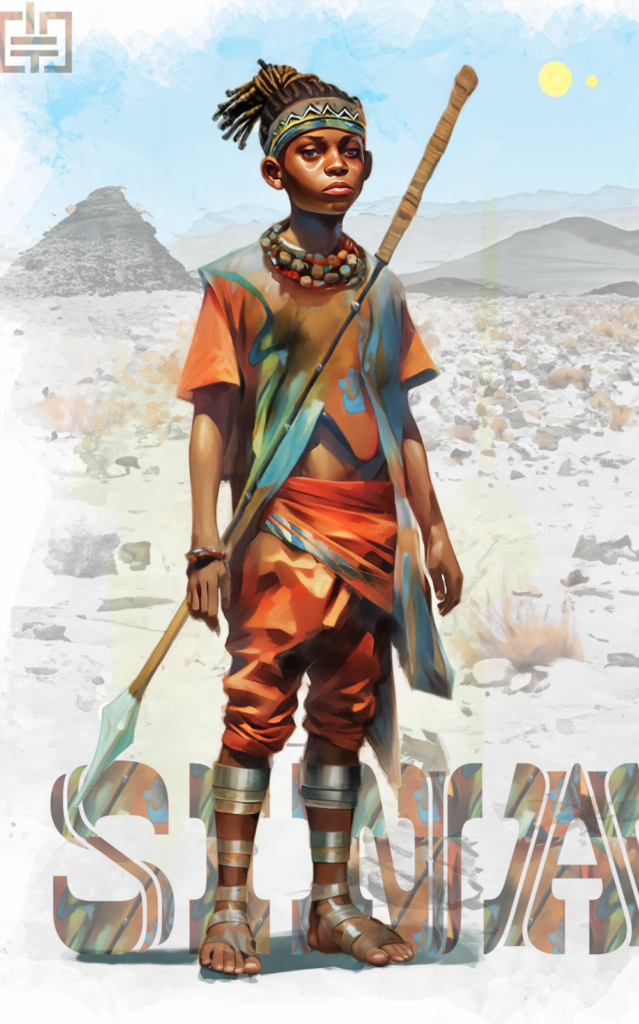
It’s a story about belief—Sina reconnects with his lost sister, Rehema’re, and finds himself. The playful oddity experiments with the musicality of text in rhyme, verse and repetition in lieu of traditional dialogue:
SINA has a stealth tread—that’s what his aunt Zawa’zawa calls it. Sometimes she calls his movement a mist walk. Zawa’zawa doesn’t like the silence about him, how Sina emerges as if from nowhere, echoless, to startle her. When she’s feeling more liberal, she calls it a mushroom walk. Mushroom, because mildews are silky. They only get chewy or fowl-like when you cook them.
He laughed at this when his aunt said it, but it’s true: beasts can’t hear him. Yet he hears them, their tiniest echo as if it were a holler. Each aura’s vibration is different from everyone else’s. Zawa’zawa echoes in spiral. It’s the whisper of a music circle, creating and sharing memories in faint caerulean light rising and falling. Wobo, wobo, deesh, deesh.
The girl, Rehema’re—it means blessing—her echo does not come with light. She speaks good Sauúti. She bends her magic, can do many things with it. Hers is a good echo. It has transition, reflection. It’s long and deep with superior timing. Wey ma. Wey ma. Uuuuuuu.
And as their parents argue about Sina’s ‘wrong’ birth:
And it was she, not him, who had to live with her parent’s regret. The echo of their discord shook the stone house, trembled Reheme’re in her own bed.
Zimpapa-zimpapa. Why—her father’s reverberation. Why, why was it he who had to carry out the fact, when it was her, Fatu’fa, who—
Pulapulapula-oooo. Her, who what?—Fatu’fa’s ululating echo. Her who cried wrong while giving birth? Did Juta’uu think she didn’t know it? Or maybe it was him who uttered a bad word as the baby was coming out! One could not be careless with echo magic. Had he dozed, and said a wrong sound in his dreaming? It harmed their child!
Their rage at themselves, at each other.
The story culminates with acceptance, the crowd’s chanting bequeathing Sina his echo name:
It’s Rehema’re who starts the chant. A chorus of echoes that grows. He wants to cry, because her echo is on song. Her echo is a pearl drum.
Wey ma, wey ma. Uuuuuuu.
And then his aunt, still holding him, chimes in.
Wobo, wobo, deesh, deesh.
He lifts his head from her embrace, and sees, hears a pealing from the parents who once ago abandoned him. He listens to their echoes.
Pulapulapula-oooo. Zimpapa-zimpapa.
Sound ricochets in a melodious opus.
Wey ma, wey ma. Uuuuuuu.
Wobo, wobo, deesh, deesh.
Pulapulapula-oooo.
Zimpapa-zimpapa.
The resonance blends into a singularity. The crowd’s fists are up, a gesture of triumph, and it’s for him. He touches his face—he doesn’t know if it’s sweat or tears. All he hears is the unmistakeable echo in that unified chant, a single word, robust and perfect, over and over:
Sina’aa!
SINA’AA!
S
I
N
A
’
A
A
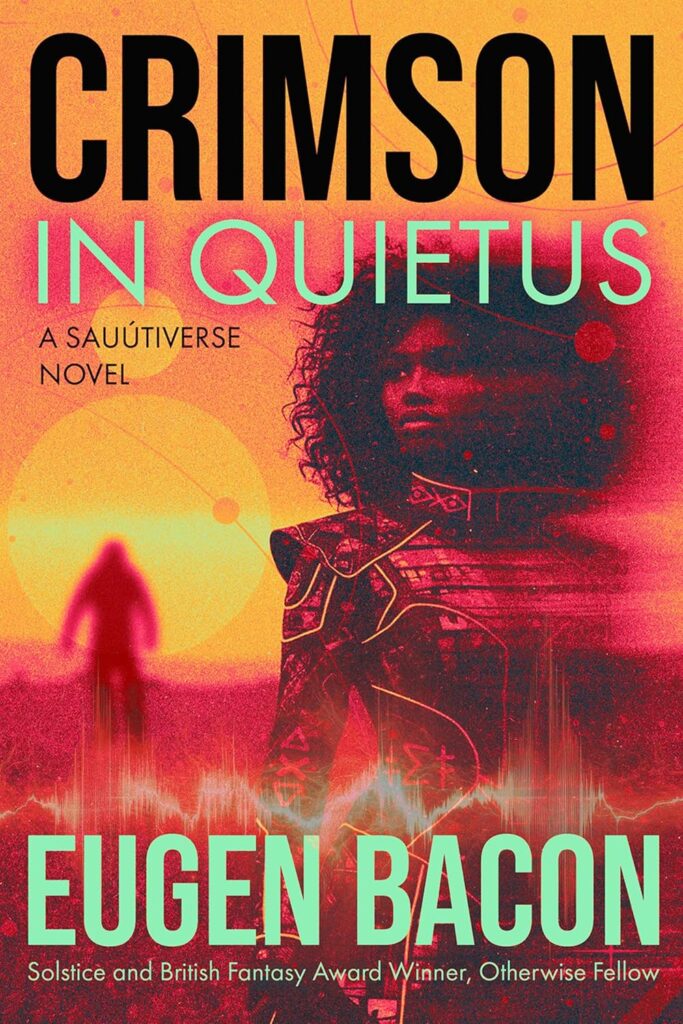
Check out my inaugural genre-bending and equally playful Sauútiverse novel, Crimson in Quietus, a new kind of literary mystery where the investigator is not a detective, but a sound magic scientist.
Learn more about Eugen Bacon on her dedicated page!